The Door Swing That Steals a Corner
Door swing furniture placement helps you position a dresser or chair without blocking the door, keeping the entrance and nearby storage usable.
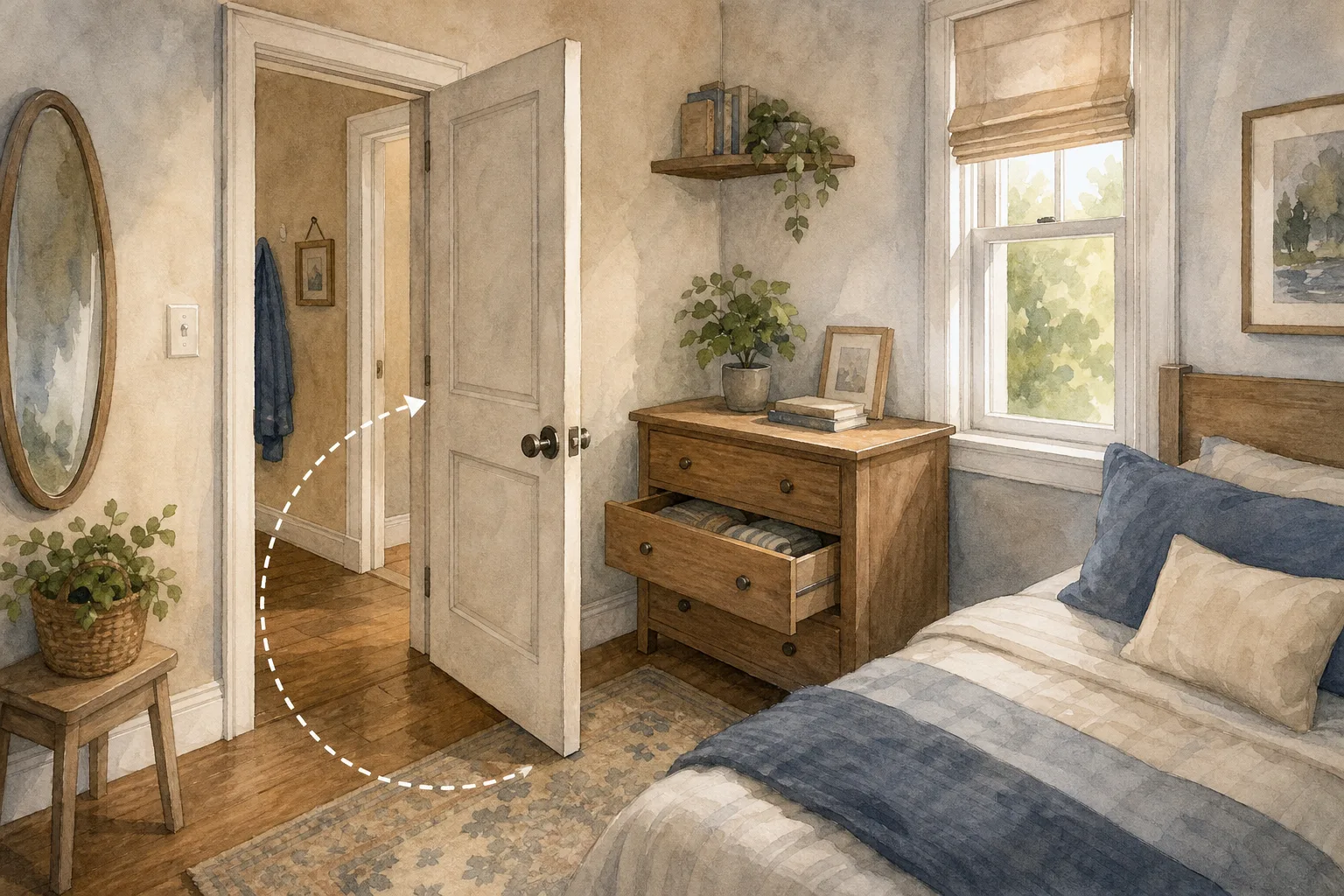
The most common door swing furniture placement mistake is treating the doorway as a line instead of a moving panel. That can leave a dresser in the door’s path, make the entrance awkward to use, or turn a useful corner into dead space. Start by checking what the door must do, then choose furniture around that requirement.
Say you have a small bedroom with an inward-opening door, a bed, and a narrow dresser beside the entrance. In this invented situation, the door opens toward the dresser wall, and the dresser has a top drawer that needs to open fully. The aim is to find a position that lets the door open, the drawer work, and the room remain easy to enter.
Decide what the doorway needs to do
Before drawing a swing arc, note the door’s everyday jobs. Does it need to open wide for carrying laundry or changing bedding? Does it usually stay ajar? Is there a light switch behind it? These details determine which positions are workable; the widest possible opening is not always the one the room needs.
Use graph paper, a ruler, a pencil, and a tape measure to sketch the walls, doorway, hinge side, windows, closet, and fixed features such as a radiator. Mark the door in its closed position and show its actual open position. If you are unsure where it stops, observe the door in the room rather than assuming it swings a full quarter-circle.
Check the handle and the door’s outer edge, too. The panel may clear a cabinet while its knob catches a drawer pull or wall trim. A doorstop can affect the opening, but do not count on one to resolve a collision unless it is already in place and the door stops where you need it to.
Choose furniture around the door’s actual landing place
Instead of treating every point in the swing as forbidden, identify the positions that matter: closed, partly open, and the usual stopping point. A low, fixed object near the wall may be less troublesome than a tall cabinet that blocks the entry or gets struck by the handle. The question is whether the door and furniture can be used without forcing a workaround.
For the bedroom, draw the dresser footprint and drawer fronts on the sketch. Compare the dresser’s corners and pulls with the door at each important position. Then check the dresser with its drawer open. A layout that works only with every drawer shut is like a drawer that opens into a wall: technically present, but not useful.
Also consider what the door covers when it is open. It might hide a light switch, interfere with access to a closet, or leave no comfortable place to pause while closing it. These are placement questions, not just collision questions.
Compare options without moving heavy furniture
Cut paper shapes for the bed and dresser, keeping them in the same scale as the room sketch. Label each shape and mark the dresser’s drawer side. Slide the pieces into different positions, then check the door’s landing place and the dresser’s open-drawer position each time.
In the invented bedroom, the first option puts the dresser beside the doorway, where the handle meets a drawer pull. Turning the dresser makes the handle miss, but leaves the top drawer opening toward the bed. The next option places the dresser on the wall beside the bed, with its drawers facing the open side of the room. That arrangement clears the door and lets the drawer open without blocking access to the closet.
Before moving the real dresser, mark the proposed corners and door position on the floor with painter’s tape. Open and close the door, check the handle, and pull an imaginary drawer from its planned front edge. If the tape shows that the door works but the drawer would meet the bed, choose another position rather than accepting a daily nuisance.
Use these checks to settle a door-swing layout?
Should furniture stay outside the whole swing arc?
Not necessarily; the useful boundary depends on where the door actually travels and what it needs to reach. Keep furniture clear of likely impacts, and make sure the door can reach its needed position without trapping access to a switch, cabinet, or passage.
What should I do if the door hits a furniture handle?
Try shifting or turning the furniture on the sketch, then check the handle against the door in its usual open positions. If no placement works, consider a different door stop or door operation only after checking the hardware and getting qualified advice for any alteration.
How can I tell whether an open drawer will block the room?
Mark the drawer front and the space it occupies when open on the same-scale sketch. Compare that shape with the places people need to stand or pass. If the open drawer overlaps a needed route or standing spot, move the furniture or change its orientation; if it does not, the layout may remain workable.
What if the door hides a light switch?
Check whether the switch is reachable as you enter and whether the door covers it in the position you use most. If access is inconvenient, try another furniture or door position; ask a qualified electrician before relocating a switch.
Make the final choice in the room
For the invented bedroom, the dresser moves to the bed-side wall, its drawers face the room, and the entry remains clear when the door opens. The result is visible in the room itself: the door reaches its intended stop without striking the dresser, and the top drawer can open without meeting the bed.
Use door swing furniture placement to solve the specific problem your doorway presents, rather than following a blanket rule about empty floor. A brief tape layout can show whether a handle, drawer, or switch is the real constraint—and which adjustment removes it without creating a new one.