How to Choose a Fold-Down Table for a Small Room
Choose a fold-down table for a small room by checking its hinges, supports, chair, and storage plan, so everyday tasks fit without constant rearranging.
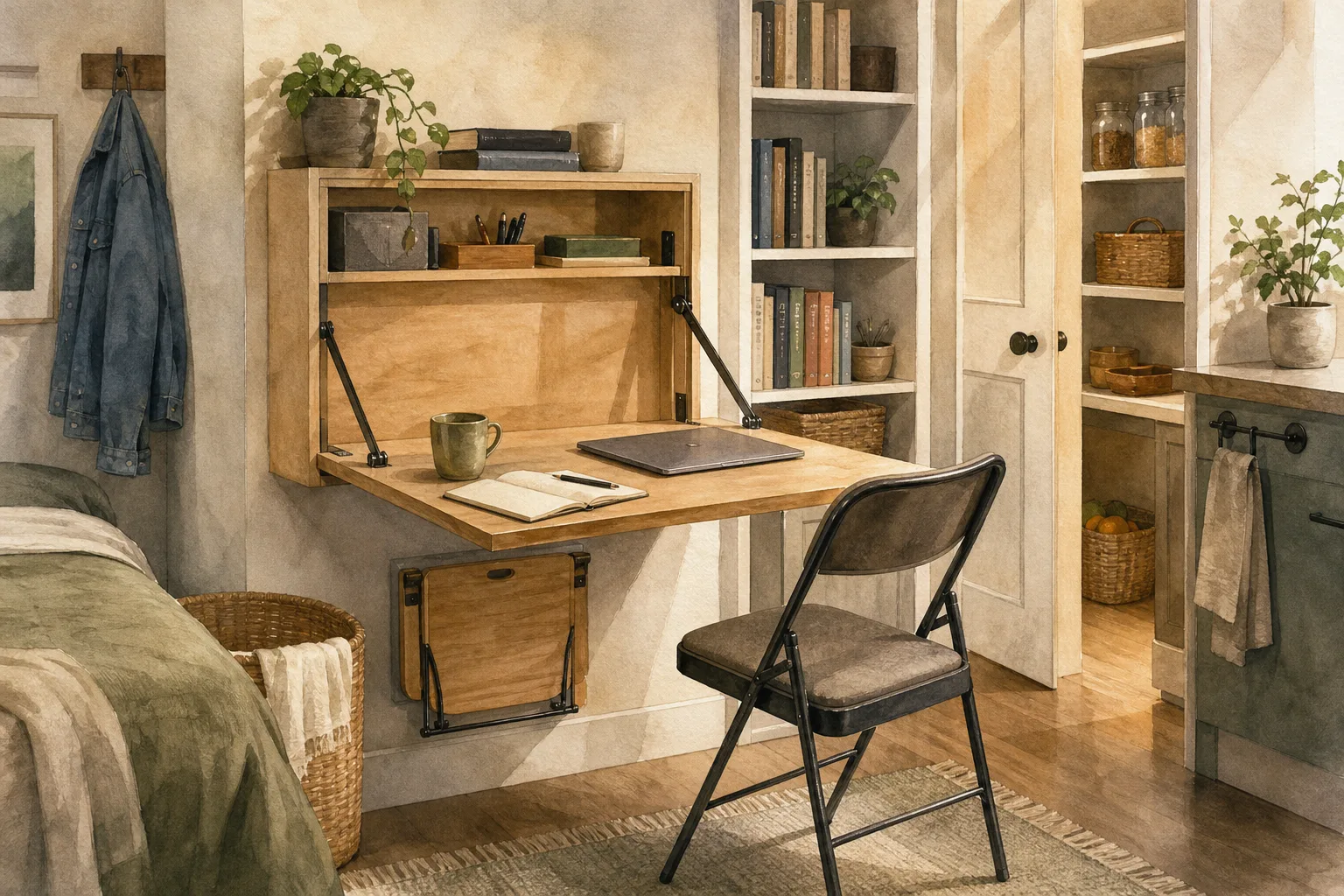
The common mistake with a fold-down table for a small room is choosing one because it looks slim when closed. A table can still be awkward if its hinge is hard to reach, its supports clash with nearby furniture, or its chair has nowhere to go. Plan for the folding mechanism and the room’s other daily uses together.
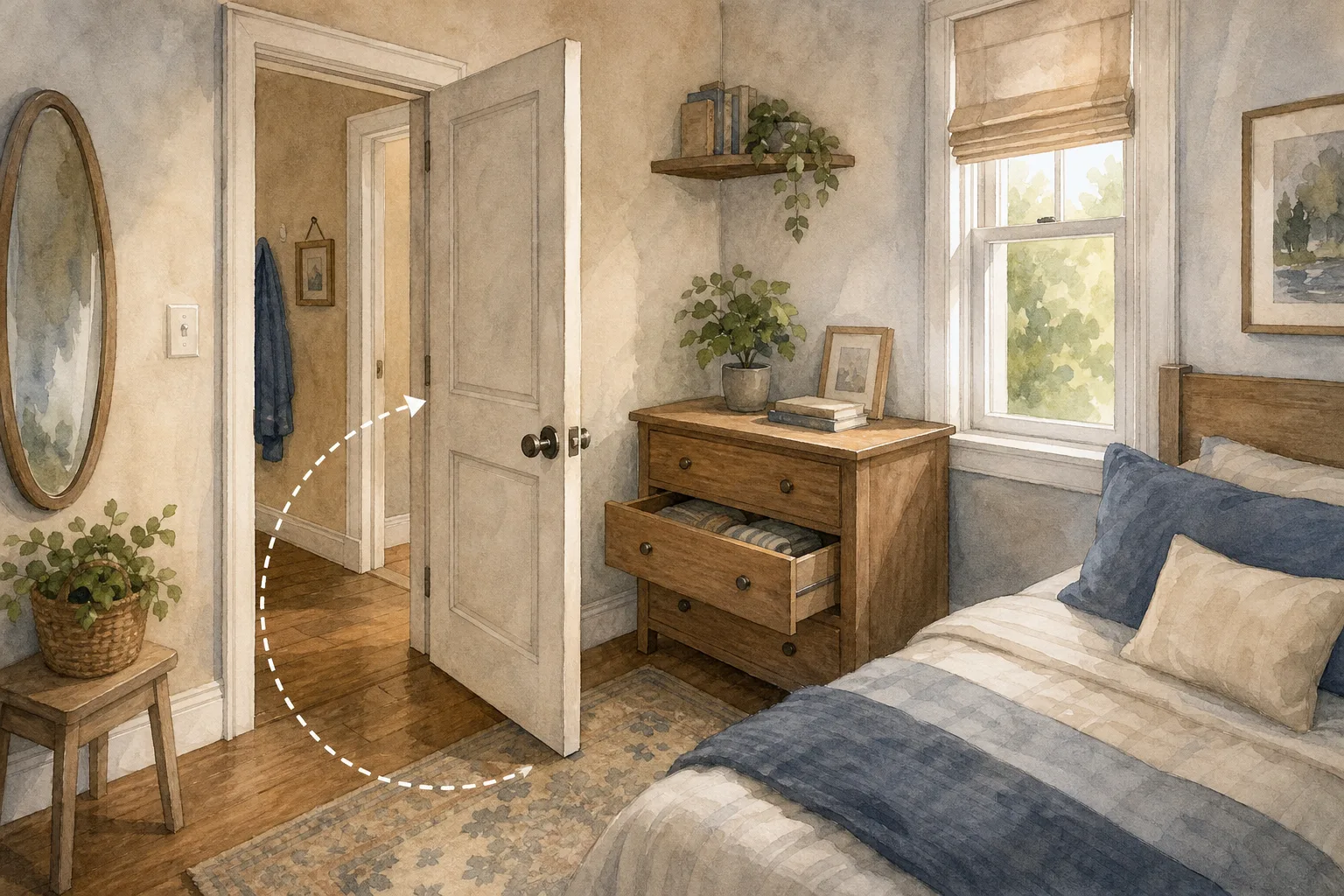
Start with what the room must do besides host the table. A bedroom may need a clear place for laundry; a kitchen corner may serve as a dining spot and a route to a pantry. Treat the folding top like a cabinet door: its movement matters as much as the space it occupies when open.
Match the folding mechanism to your routine
Fold-down tables use different mechanisms. A wall-hinged top may rely on folding legs, a support frame, or brackets that lock into place. A gateleg table, by contrast, uses a hinged leaf supported by a leg or frame that swings outward. Each design asks you to do something different before the top is ready to use, so consider who will open it and how often.
Before buying, check the product instructions for how to release, lower, support, and fold the top. Look for handles or catches you can reach without leaning over a chair, and note whether the table needs both hands or a particular sequence. If a support must be positioned manually, make sure its path is not blocked by a radiator, baseboard, cabinet, or stored item.
Try the mechanism in a showroom if possible, or ask the seller to demonstrate it. Notice whether the top moves smoothly under ordinary handling, whether the supports settle into their intended position, and whether folding it requires you to clear objects first. A simple mechanism that suits your routine is often more useful than an elaborate one that demands extra rearranging.
Check what the folding hardware needs around it
Look beyond the tabletop. Hinges, brackets, legs, latches, and support arms can extend beyond its edges or need room to swing. Use the product diagram and installation instructions to identify those parts. Then mark the proposed table location with painter’s tape and use a cardboard strip to trace the support’s movement where it will meet nearby shelves, handles, or trim.
Say you are considering a wall-mounted table beside a bookcase. The diagram shows a support arm that swings toward the shelf. You mark the table’s position with tape and move a cardboard strip through the arm’s path; it would meet the bookcase handle, so you compare another location or a model with a different support design. That gives you a choice based on the actual mechanism, rather than the tabletop alone.
Also check the folded hardware. A latch or leg can catch a curtain, interfere with a door handle, or make the table difficult to stow. Wall construction and fixing requirements depend on the product and the surface. Follow the manufacturer’s installation instructions, but do not decide that a fixing method is suitable for your wall based on a visual match or guess. If the wall type, fixing, or support capacity is uncertain, pause and ask a qualified installer to assess the installation before mounting the table.
Give the chair and supplies a home between uses
A folding top does not solve the room’s storage problem by itself. Decide where the chair will go before choosing the table. A backless stool may slide beneath a surface if the supports allow it; a folding chair may hang on a suitable hook; a chair with arms may need a separate spot. Check the chair’s shape against the table’s underside and hardware.
Keep regular supplies together and out of the mechanism’s path. A shallow drawer, wall pocket, or lidded box can hold placemats, pens, or a notebook, depending on the table’s job. A cable clip can guide a charger cord away from a hinge, while a small tray can keep loose items off the floor. Avoid placing objects where they must be shifted every time the table opens.
For a room with two jobs, assign each item to one of them. In a bedroom that doubles as a work area, keep work supplies in a box that can be moved to a shelf when the table is folded. Then putting the table away does not mean searching for the chair or sorting a pile of mixed belongings.
Check the table against the room’s other daily jobs
Consider what the room needs to do while the table is open and while it is stored. A dining table may compete with access to a pantry; a desk may occupy the spot where a laundry basket normally stands. Open nearby cabinet doors and drawers, and check whether the table’s supports interfere with them. The goal is not to make every activity happen at once, but to know which tradeoff you are accepting.
Use a routine that resembles real life: set down the items you normally use, open the table, position the chair, and then fold everything away as you would on an ordinary day. Notice whether you have to move a lamp, unplug a cord, or lift the chair over a support. These small demands are part of using the mechanism, not flaws in the room’s appearance.
Keep the folded setup purposeful. The space under the table might hold a stool, a basket, or nothing at all, depending on what the supports allow and what the room needs. If an object must be moved before every opening, choose a different home for it or consider a design that leaves the area more accessible.
How do you choose a fold-down table for a small room?
Are wall-mounted fold-down tables safe to install on any wall?
No. Suitable fixings and support depend on the wall construction and the specific table. Follow the product instructions, and ask a qualified installer to assess the wall and fixing if either is uncertain.
Is a folding-leg table different from a wall-bracket table?
Yes. Folding legs swing into the room and support the top from below, while brackets or a support frame attach to the wall and may have their own release and locking action. Check the operating instructions and movement of the exact design you are considering.
Can a fold-down table work for dining and desk use?
It can, provided the surface and supports suit both tasks and you have a plan for the chair and supplies between uses. Consider whether dining items need to be cleared before work materials come out, and where each set will be stored.
What should I put beneath a fold-down table?
Choose an item that does not obstruct the legs, brackets, or support movement, such as a stool that can be moved easily if the design allows it. Check the manufacturer’s instructions and the table’s full opening and closing action before placing anything underneath.
Use a concrete decision list before you buy
Work through these checks with the product diagram, installation instructions, and furniture you already own. For each observation, choose the action that follows rather than relying on appearance alone.
- Support movement: Check whether the legs or arms complete their path without hitting a shelf or handle. If they clear it, keep the proposed location; if they collide, try another location or compare a different mechanism.
- Release and latch: Check whether you can reach the release and whether the support locks as the instructions describe. If both actions are clear and comfortable, keep the model on your shortlist; if either is awkward or unclear, choose a design with a more accessible mechanism.
- Chair storage: Check whether your chair fits beneath the folded table or has a clear storage place. If it does, assign it that spot; if it does not, choose another chair or revise the table location.
- Supplies: Check whether regular items have a place that does not cover a hinge, latch, or support. If they do, keep that storage plan; if they sit in the mechanism’s path, move them to a shelf or select a different container.
- Other room tasks: Check whether the open table blocks a cabinet, drawer, or appliance you need to use. If the conflict suits your routine, keep the arrangement; if it does not, relocate the table or consider another design.
- Installation assessment: Check the product instructions and identify whether the wall type and required fixing are known. If the wall and fixing suitability are uncertain, do not mount the table yourself; have a qualified installer assess the wall and installation. If the installer confirms an appropriate method, proceed through the qualified installation; if not, choose a location or table with a suitable installation plan.
Imagine a renter planning a work corner beside a bookcase, with a wall-mounted table, a folding chair, and a box of notebooks. The product diagram shows an arm that would strike the bookcase handle, so they mark a second location with painter’s tape and trace the arm’s path with cardboard; this time it clears. They set the chair in the proposed storage spot and find it blocks a drawer, so they switch to a backless stool that fits beneath the folded top, then put the notebooks in a wall pocket away from the hinge. Because they are unsure what the wall can support and cannot make that judgment from the instructions alone, they ask a qualified installer to assess the wall and fixing before installation. The resulting plan preserves the drawer, gives supplies a place, and leaves the final mounting decision to someone qualified.
A fold-down table for a small room works best when opening, using, and storing it fit the room’s ordinary routine. Give the mechanism, chair, and supplies workable places, and check wall suitability with a qualified installer whenever it is uncertain; the freed floor can then serve the room’s other daily needs.