A Worktop Surface That Can Live with Water
Choose a water-resistant worktop surface that suits your kitchen’s wet zones and daily tasks, with practical checks for care, seams, and sink details.
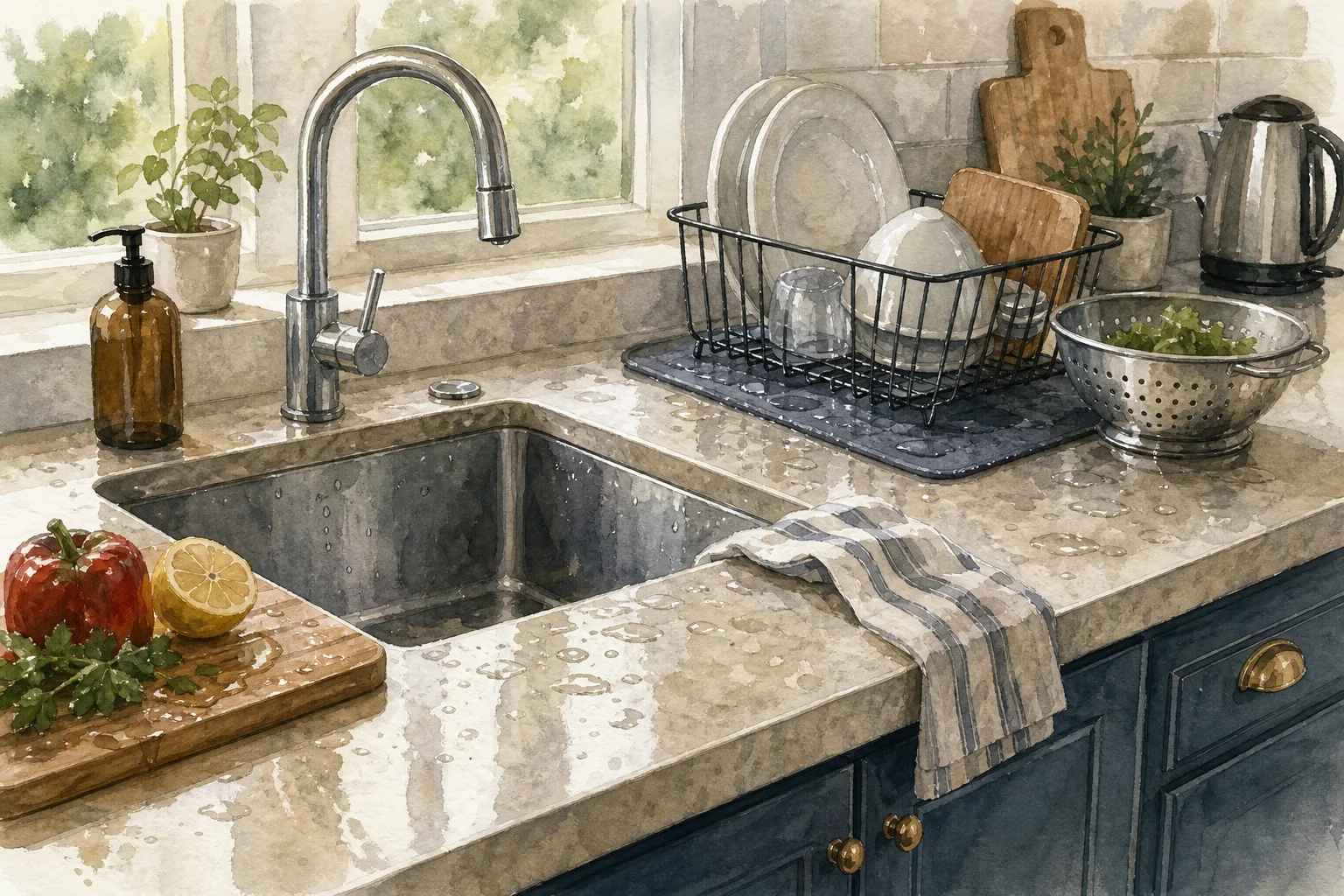
The common mistake with a water-resistant worktop surface is choosing from a dry sample and expecting it to cope with a wet sink, a dripping dish rack, and every kitchen task. The cost is a mismatch between daily habits and the care the installed surface actually needs. Start by noticing where water lands and how long it stays there.
Water resistance is only one part of the decision. Standing water, damp cloths, cooking spills, hot cookware, cutting, seams, and the finish all matter. A counter beside the faucet faces a different routine from one used mostly for rolling pastry.
Map where water reaches the worktop
For a few ordinary days, notice which areas get wet and why. Water may come from handwashing, rinsing vegetables, filling a kettle, wiping the counter, or setting down a colander. It can collect around the faucet base, along a seam, or where the counter meets a wall.
Separate brief splashes from water that tends to linger. A quick wipe is different from a damp sponge left in a corner or a dish rack that stays wet. Persistent moisture can put more demands on edges and joints, and may point to a layout issue as well as a material choice.
- Sink zone: Observe whether splashes reach the faucet, soap dispenser, or sink rim. If they do, ask how the exact product and sink joint should be cleaned and maintained; if they do not, focus the same questions on the areas that do get wet.
- Dish-drying zone: Check where drips run from the rack, mat, or washed pan. If water lands on a seam or exposed edge, ask the fabricator how that detail is finished; otherwise, choose a rack position that keeps drips contained.
- Preparation zone: Notice whether rinsed produce or a wet cutting board sits on the counter. If it does, plan a drying mat or board and check the product’s cleanup guidance; if not, compare materials against the tasks that happen there.
- Wall edge: Look for water behind a kettle, coffee maker, or sink. If moisture repeatedly reaches the wall joint, ask how the backsplash connection is finished; if it stays dry, prioritize other exposed edges.
- Seams and cutouts: Ask how joins, faucet holes, and the sink opening are treated. If the supplier cannot explain the detail for the exact product, request clarification before fabrication; if the answer is clear, keep the care instructions with the project documents.
This map helps you compare like with like. A countertop may have a face designed to cope with ordinary moisture while its seams, underside, or exposed edges need different protection. Ask the supplier or fabricator about the complete installation, not just the sample.
Compare material families by their care demands
Solid surface, quartz composite, natural stone, laminate, tile, and wood bring different trade-offs. Product names alone do not settle the question: composition, finish, construction, seam placement, and care instructions all matter. Use broad material descriptions to form questions, then verify answers against the exact product documentation and proposed installation.
Quartz composite needs product-specific heat and cleaning guidance
Quartz composite contains mineral material and binding resins. Some products are described by their manufacturers as nonporous and do not call for the same routine sealing associated with some natural stones. That does not settle how a particular product handles heat, stains, cleaners, or water at its joints.
Follow the manufacturer’s directions for cleaning, hot pans, and spills; do not treat the surface as a cutting board unless the product instructions explicitly allow it. Ask whether the specific finish shows water marks or fingerprints readily, and what to do if a stain or damaged joint appears.
Natural stone varies by stone and finish
Granite, marble, and other natural stones differ in porosity, hardness, finish, and care needs. Some products may call for sealing, while others have different guidance. Sealing can help with staining on products for which it is recommended, but it does not make every stone suitable for standing water or every cleaning product.
Marble can appeal to someone who likes its distinctive veining and accepts that acidic ingredients such as lemon juice or vinegar may affect some finishes. Granite is often selected for kitchens, but its care also depends on the particular stone and finish. Ask for instructions for the actual slab, including spill response and approved cleaners.
Laminate needs attention at exposed edges and openings
Laminate has a decorative surface bonded to a core. Its face is generally straightforward to wipe, but edges, seams, and openings deserve close attention near a sink. If moisture reaches a vulnerable core, damage may follow; the risk and appropriate precautions depend on the product’s construction and installation.
Ask how the counter is joined and how the sink opening is protected. Compact laminate can have a different construction from conventional laminate, so check the exact product specification rather than treating the names as interchangeable. Use a trivet for hot cookware and a cutting board for knife work unless the maker’s instructions say otherwise.
Solid surface can offer discreet seams
Some solid-surface installations can be joined with discreet seams, depending on the product and fabricator. That can create a continuous-looking counter and simplify cleaning around certain transitions. Ask how repairs are handled, whether the finish can be renewed, and what care applies to the specific surface.
Heat guidance varies by product. Keep hot pans and sharp knives off the counter unless the manufacturer explicitly permits those uses. At a sink, ask how the sink and counter meet and how that joint should be cleaned and maintained.
Tile and wood call for attention to joints and finish
Tile may cope with routine splashes, but grout can discolor or absorb moisture depending on the grout, installation, and any sealer used. The detail at the sink, wall, and counter edge matters as much as the tile face. Ask what grout and sealant are specified and follow their care instructions.
Wood brings warmth and can suit tasks such as pastry preparation, but it needs a finish intended for its use and care that matches the maker’s directions. Water left near a sink may mark or damage wood, particularly where a finish is worn or a joint is exposed. Some households use wood on a separate island or prep area and choose another material beside the sink.
Check heat, knives, cleaners, and spills separately
A surface may handle ordinary splashes yet still need protection from heat, knives, abrasive cleaners, or dropped cookware. Conversely, a material suited to a particular kitchen task may have seams or finishes that need prompt attention. Compare each surface against the jobs you expect it to do rather than asking whether it is simply durable.
- Chopping: Check the maker’s guidance. If direct cutting is not explicitly allowed, use a cutting board; if it is allowed, follow the stated limits and care directions.
- Hot cookware: Check heat instructions before setting down a hot pan. If the maker calls for protection or the guidance is unclear, use a trivet; otherwise, follow the stated use conditions.
- Acidic ingredients: Check spill guidance for lemon juice, vinegar, tomato, and similar ingredients. If prompt cleanup is advised, wipe the spill as directed; if the guidance is unclear, ask the supplier before relying on the surface.
- Appliances: Observe whether steam from a kettle or coffee maker repeatedly reaches a wall edge or underside. If it does, change the appliance position or ask how that edge is protected; if it does not, check other likely sources of moisture.
- Cleaning: Check the approved cleaner list. If a product or pad is not approved, choose a recommended alternative; if the care sheet is missing, request it rather than guessing.
Imagine a hypothetical kitchen where the owner washes produce at the sink, chops vegetables on the adjoining counter, and sometimes sets down a hot saucepan. The owner notices that the dish rack drips beside the sink, then checks the chosen worktop’s instructions and sees that the maker recommends a trivet and prompt cleanup but does not explicitly allow direct cutting. The owner plans to use a cutting board, keeps a trivet near the cooking area, and moves the rack so its drips land over the sink or a mat. The expected observable result is a setup that follows the product guidance and gives each task its own surface or tool, rather than expecting the worktop to serve as sink, chopping board, and pan rest.
Inspect the sink opening, seams, and wall edge
Water problems can start at a transition. A counter face may look sound while a seam catches debris, a backsplash joint needs attention, or an unprotected cutout leaves the substrate vulnerable. Before choosing, ask to see a finished edge and a sample of the proposed seam or sink detail.
- Sink opening: Ask how the cut edge is finished for the exact product. If the installer cannot specify the method, request details before fabrication; if the method is clear, confirm how to maintain it.
- Seam position: Check where seams will fall relative to the faucet, sink, and dish rack. If a seam sits where water regularly lands, ask whether the layout can change or how the seam should be cared for; if it does not, still confirm the seam treatment.
- Exposed ends: Look at how open ends are finished. If the detail differs from the main face, ask whether it changes cleaning or moisture care; if the finish is continuous, verify that this applies to the installed product.
- Wall connection: Ask how the counter meets the backsplash or wall. If the joint needs inspection or upkeep, get the relevant instructions; if it does not, clarify what to watch for if water reaches that area.
- Repair plan: Ask how a damaged edge, failed joint, or stained area is addressed. If the answer requires a specialist, identify the appropriate professional; if ordinary household care is sufficient, request the approved method in writing.
- Installation conditions: Ask whether the substrate, plumbing, or wall needs preparation. If the installer identifies an uneven or unsuitable surface, have a qualified professional assess it before fitting; if the conditions are suitable, confirm who is responsible for the final checks.
For an undermount sink, scrutinize the exposed counter edge and the joint between sink and worktop. With a top-mounted sink, inspect the rim and seal. Neither arrangement eliminates upkeep; the details differ. Have a qualified installer assess the substrate and installation requirements, especially around plumbing or an uneven wall.
Choose care instructions that fit your household
Care guidance matters most when it fits the household’s habits. If you usually wipe the counter as you cook, prompt cleanup may feel natural. If dishes often sit overnight, a surface or layout that depends on immediate drying may become a source of friction. Be candid about the routine you can sustain.
Before committing, ask the supplier for written care guidance for the exact product and finish. Clarify whether sealing is required, which spills need prompt attention, how to remove ordinary marks, and what not to use. A sample board helps you see color and texture, but cannot show how the full installation’s joins and cutouts will be handled.
- Water pattern: Check whether the counter gets quick splashes or stays damp. If moisture lingers, prioritize a product and installation whose care guidance suits that exposure; if it does not, compare the other tasks performed there.
- Main tasks: List the work done at the counter. If you chop or set down hot cookware, plan a board or trivet unless the maker explicitly permits direct use; if you do not, focus on the tasks you do perform.
- Care routine: Check whether the product needs sealing or specific cleaning. If that upkeep feels unrealistic, choose another product or a different location for it; if it seems manageable, keep the written directions accessible.
- Visible wear: Ask whether water marks, etching, scratches, or grout changes are expected for the exact finish. If they would bother you, compare another finish or view a sample in your kitchen’s light; if they would not, confirm the care requirements still fit.
- Repair approach: Ask how chips, stains, damaged grout, or a failing joint are addressed. If the repair method or responsibility is unclear, resolve it before purchase; if it meets your expectations, keep the details with the product information.
- Installation detail: Confirm how the sink opening, backsplash, seams, and exposed ends are finished. If any detail is unspecified, request a written answer before fabrication; if all are clear, verify the installer and supplier agree on the same plan.
Which worktop details should you ask about?
Does a water-resistant counter mean water can sit on it?
No. Water resistance describes performance under specified conditions, not permission to leave puddles indefinitely. Follow the product’s care instructions and pay particular attention to seams, edges, and sink joints.
Should every stone worktop be sealed?
No single rule applies to every stone, finish, or product. Ask the supplier or fabricator whether the specific stone needs sealing, which product is appropriate, and how to tell when care is due.
Is a sealed sink joint maintenance-free?
No joint should be treated as maintenance-free. Follow the installer’s guidance, and ask a qualified professional to assess a seal that separates, cracks, or allows water behind the counter.
Can one material cover the whole kitchen?
It can, but it does not have to. A sink-side counter and a separate prep island can use different materials if each product suits its intended tasks and the transition is designed and installed appropriately.
Let the wettest routine guide the worktop choice
A sensible water-resistant worktop surface choice begins where your hand reaches for a sponge or your dish rack drains, not with a broad claim on a sample label. Compare water exposure, everyday care, and the work each section must handle; then verify how the exact product is finished at the sink and edges.
One useful last check is to ask the supplier to connect each care instruction to a real detail in your kitchen: the sink cutout, the seam near the faucet, or the spot where a dish rack drains. That makes the material choice easier to maintain because the product guidance and the installed layout are considered together.