Measure a Sofa Delivery Route Before You Buy
Measure a sofa delivery route before you buy to identify access snags, confirm handling details with the delivery provider, and choose a model that can reach its room.
The most common sofa-buying mistake is checking only whether it fits the living room. A sofa delivery route can bring a different problem: a boxed component may not clear the building entrance, elevator, stairwell, or final doorway, leaving you to arrange another model or delivery plan. Check the route and the provider’s handling requirements before ordering.
Get the delivery details that affect access
Ask the retailer or delivery provider for the dimensions of each package or component, not just the assembled sofa’s width, depth, and height. A sofa may arrive with legs removed, in separate modules, or inside packaging that adds bulk. Confirm which parts can be detached, how they are protected, and what carrying positions the provider permits.
Write down the dimensions for every piece that must pass through the building: the sofa body, chaise, legs, or separate modules. Ask whether the provider can assess your route from those details and your photos or measurements. A product-page diagram usually describes the sofa in the room, not necessarily the form in which it will be delivered.
Do not count on a crew turning or tilting a sofa to solve a tight spot. The workable position depends on the sofa, its packaging, the route, and the provider’s handling rules. Ask the delivery provider directly what positions are allowed and whether the specific route appears workable; if they cannot confirm, treat access as unresolved before booking.
Document the route as a delivery sequence
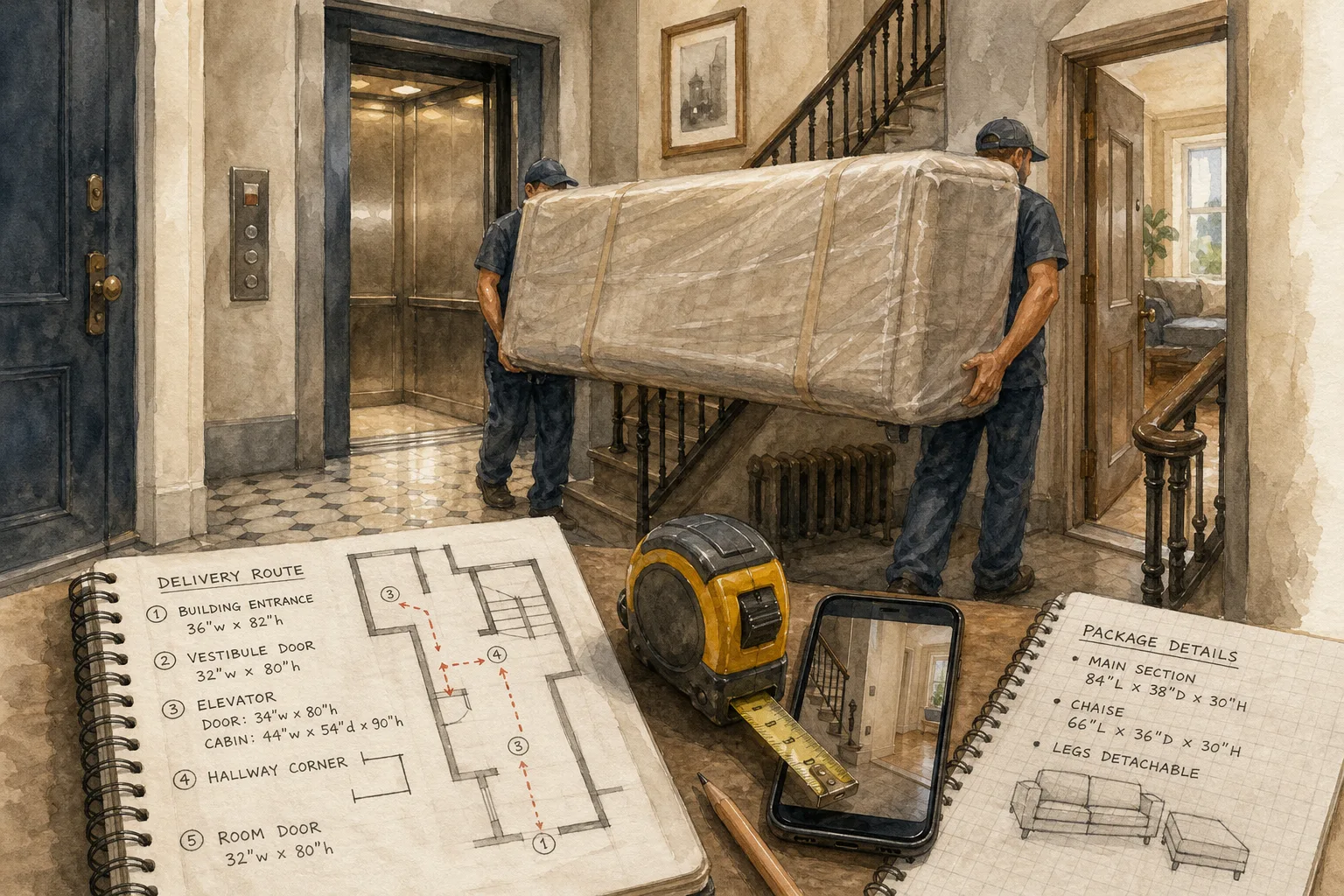
Start where the delivery team will unload and follow the actual path to the room. Record each transition in order: building entrance, vestibule, elevator or stairs, hallway, and room entrance. If the provider will use a garage or side door, confirm that this entrance is available to the crew and include it in your notes.
For each doorway, note the narrowest usable opening and the height. Measure between the door stops, and account for a door, handle, closer, or trim that limits the clear space. For an elevator, record the door opening and the interior space, then ask the provider whether its stated handling position can work in that car.
For a hallway or stairwell, note protruding handrails, radiators, wall lights, low ceilings, and landings. Rather than treating these as general room-layout obstacles, describe where they occur along the delivery sequence and photograph them from the direction the crew will approach. Those details help the provider assess the actual carrying problem.
Focus on the points where delivery may stop
Turns, landings, and transitions between stairs and hallways deserve special attention. Record the clear space at the corner, nearby doorframes or railings, and any overhead obstruction. A sofa’s length can matter as much as its cross-section because a long item may need room to change direction.
For stairs, note the clear width, handrail position, ceiling or soffit height, and the shape of each landing. Send the information to the delivery provider and ask for a route-specific assessment. A straight measurement alone cannot establish whether a particular sofa can be carried around a turn.
Think of the packaged sofa like a parcel that must pass through a series of checkpoints: clearing one doorway does not mean it can make the next turn. Keep the sequence and the package details together, so the provider can consider the route as a whole rather than responding to a single opening.
Use each finding to decide what to do next
- Package dimensions are available: If you have dimensions for every section, send them to the delivery provider with your route notes; if a component is missing, ask the retailer for it before relying on the assessment.
- A doorway has a tight clear opening: If the provider confirms the specified package and allowed position can pass, keep that confirmation with your order details; if not, ask about a smaller module or choose another sofa.
- An elevator is part of the route: If the provider says the package can be loaded and handled in that elevator, include the elevator details in your delivery plan; if not, ask whether another authorized route is available or select a different model.
- A stair landing has limited turning space: If the provider assesses the exact landing and handling position as workable, flag it for the crew before delivery; if the answer is uncertain, pause the order or choose components that avoid the problem.
- A fixture appears to block the route: If you have permission and the provider confirms removal is appropriate, arrange it before delivery; if not, leave it in place and ask about another route or sofa configuration.
- Packaging details remain uncertain: If the retailer supplies the missing information, update the provider’s assessment; if it cannot be obtained, do not assume the assembled dimensions are enough to establish access.
- The provider cannot confirm a difficult turn: If a delivery assessment resolves the concern, save the instructions and share them with the crew; if it does not, choose a model with a route the provider can assess clearly.
Work through a delivery decision with real inputs
Imagine you are considering a sofa with a boxed main section and a separate chaise. Your notes show that the main section must pass through a narrow vestibule, ride an elevator, and turn at a stair-free hallway corner. First, you ask the retailer for both package sizes and whether the legs detach. Next, you send those details, photos, and the measured access points to the delivery provider and ask which carrying positions are permitted. The provider confirms the vestibule and elevator route but cannot assess the corner from the information supplied. You send a closer photo and the corner clearance; if the provider then approves that route, you can proceed while keeping its instructions for delivery day. If the corner remains uncertain, the practical decision is to select a smaller configuration or another sofa rather than rely on an unconfirmed tilt.
Prepare only after the route has been assessed
Once the provider has reviewed the route, clear the agreed path of shoes, side tables, floor lamps, and loose rugs. Move fragile wall decor, protect vulnerable surfaces with suitable covers, and keep pets and household members out of the carrying area. If the route crosses a shared building, confirm access arrangements with the person responsible.
Tell the crew about the assessed pinch points before carrying begins, and show them the route notes or photos. Do not substitute a different entrance or remove a fixture at the last minute without checking that the change is permitted and workable.
What should you ask about sofa delivery access?
Should I measure the sofa or its packaging?
Ask for the dimensions of every package or component that must travel through the building. If those details are unavailable, ask the delivery provider what information it needs to assess access before you order.
What should I measure at a doorway?
Record the narrowest usable width and height, accounting for the door, stops, handle, and closer. Share those figures with the delivery provider along with the dimensions of the relevant package.
Can the delivery team turn a sofa on its side?
Handling positions depend on the sofa, packaging, route, and provider’s rules. Ask the provider about the specific model and delivery path rather than assuming it can be tilted through a tight point.
What if the provider cannot confirm access?
Ask whether a modular version, detachable part, or different authorized route would address the unresolved point. If access still cannot be assessed, choose a model with a delivery route the provider can confirm.
Keep the route assessment with your order
A sofa delivery route check is most useful when the retailer’s package details and the provider’s handling guidance are considered together. Save your route sequence, photos, and any written instructions with the order, then share them with the crew before carrying starts. That gives you a clearer basis for choosing a sofa that can make the full trip to its room.