Decluttering Without a Keep-or-Discard Pile
Decluttering without a keep-or-discard pile helps you make clearer choices by separating uncertain, shared, and ready-to-remove belongings before acting.
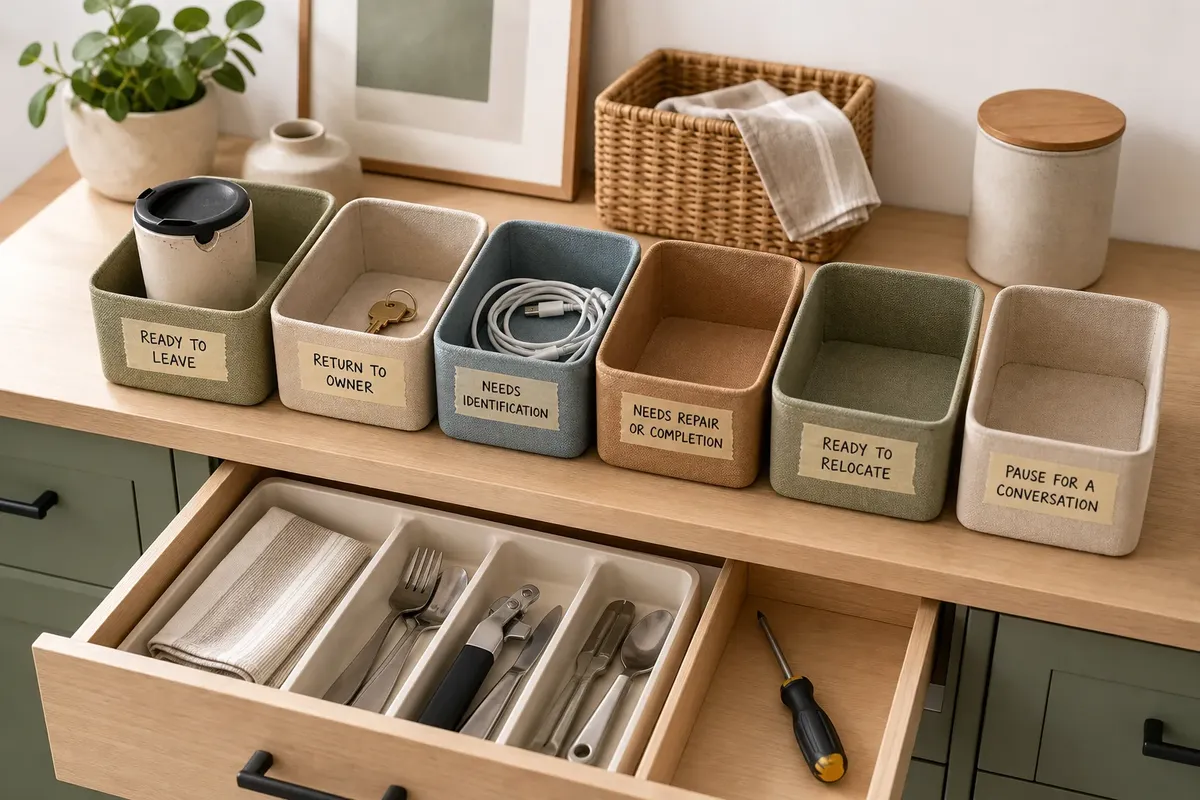
Decluttering without a keep-or-discard pile works best when you decide what action an item needs before deciding whether it stays. A chipped travel mug, a spare key, and an unidentified cable shouldn’t face the same question: one may be ready to leave, one needs its owner, and one needs identifying.
Instead of sorting by similarity, sort by the next decision. That keeps attention on what you can responsibly do now, without turning a drawer into a debate over every object.
Why sort by decision instead of by type?
Grouping similar belongings can reveal duplicates, but it can also lead to the same pile-and-review routine. A more useful first pass separates items by what is stopping a decision: condition, ownership, missing information, or a clear next action.
This distinction matters in shared homes. You can decide that your own broken pen is ready to go, but a roommate’s key needs to be returned. An unknown cable needs identification before anyone can judge whether it is useful.
Begin with the question each item raises, not with a category label.
Which decision groups should you make?
Use a few visible destinations, each tied to an action. A basket, paper bag, or cardboard box works; label it with painter’s tape if the destination might otherwise be unclear.
- Ready to leave: Check whether the item is yours to remove and whether it is unusable or no longer wanted. If both are clear, choose an appropriate disposal or donation route; if not, move it to the owner or information group.
- Return to owner: Check whose belongings they are and whether that person is available to decide. If the owner is known, set the item aside for them; if ownership is uncertain, place it in the identify group rather than handing it to a guess.
- Needs identification: Check for a label, matching part, or device it may belong to. If you can identify it, take it to the person or place responsible for it; if you cannot, keep it in a contained, marked spot pending a specific follow-up.
- Needs repair or completion: Check whether the item is broken, missing a part, or waiting for a small repair. If a sensible repair is available and someone agrees to handle it, set it aside for that action; if not, decide whether it should leave or go to its owner.
- Ready to relocate: Check whether the item has a known destination elsewhere in the home. If the destination is clear, carry it there now; if not, return it to the decision area until someone chooses a suitable place.
- Pause for a conversation: Check whether the item is shared, sentimental, or subject to someone else’s choice. If the relevant person can weigh in, ask them; if they are unavailable, keep the item separate and note who needs to decide.
Keep the groups broad enough to act on. A label such as “needs a decision” is less useful than “ask Maya about the photo album,” because the second label names the next move.
How do you move each group forward?
Review one destination at a time. Start with the group that has the clearest next action, such as returning a known item to its owner. Then handle items that need information or a conversation, and leave removal decisions until you know the belongings are yours to decide about.
For anything leaving the home, choose a real route rather than an indefinite holding box. Depending on the item and local options, that might mean household disposal, a donation organization that accepts it, or a suitable recycling program. Check the relevant instructions when an item’s materials or condition affect the choice.
Keep the process small: work on a single drawer, countertop, or cabinet section, and stop before the contents become one large heap.
What if an item needs more context?
What should I do with an unidentified cable?
Look for markings and compare the connector with devices in the home, without forcing it into a port. If you still cannot identify it, put it in a labeled “identify” container and name the person who may recognize it; do not discard it based on appearance alone.
Can I declutter someone else’s belongings?
You can separate them for the owner, but the owner should make the choice about keeping or removing personal belongings. If the owner is unavailable, leave the items together in a clearly marked place rather than treating silence as permission.
What if an item has no obvious destination?
Hold it outside the active sorting area and ask who uses it and where it would be needed. If nobody can name a destination, revisit whether it belongs in the home; if ownership or use remains unclear, keep it contained until the right person can decide.
How should I handle sentimental belongings?
Separate them from routine household decisions and allow the owner to consider them without pressure. If several people share the attachment, agree on who will make the decision before anything is moved or removed.
What does this look like in a real drawer?
Say you open a kitchen drawer containing a cracked travel mug, a roommate’s spare key, an unlabeled cable, and a working screwdriver that belongs in the tool cabinet. First, you check ownership: the mug is yours, the key is your roommate’s, the cable is unknown, and the screwdriver is yours. Next, you inspect the mug and decide you no longer want it; you place it in the appropriate exit group after checking what disposal route suits its material. You put the key in a marked return-to-roommate spot, place the cable in a small identify container, and carry the screwdriver to the tool cabinet.
The resulting decision is concrete: one item has a removal route, one awaits its owner, one awaits identification, and one is already back where it belongs. No one has to infer a decision from a mixed pile.
How can you keep a shared sorting session fair?
Agree on who can decide about which belongings before the session begins. Each person can move their own items, while shared or uncertain items go into a conversation group. This boundary prevents a fast sort from becoming an argument about authority.
Make every paused item point to a person or next action. “Ask Jordan about the framed print” is actionable; “maybe” is not. If a pause has no owner or follow-up, it is likely to become another abandoned pile.
Decluttering without a keep-or-discard pile is not about avoiding choices. It is about matching each choice to the information and authority it requires. When a mixed area stalls, sort by the next decision, then give every unresolved item a named person or action before you stop.
Keep looking
The Landing Zone: Why Everyday Items Need a First Stop
A landing zone for everyday items gives keys, bags, and actionable mail a clear home near…

Open Shelves or Closed Cupboards for Things You Use Often?
Choose open shelves or closed cupboards for kitchen items you use often by weighing visibility, cleaning,…